Is Your Business Technically Ready for AI in 2027?
Discover gaps in your data, applications, infrastructure, and AI adoption readiness with ISHIR’s Technical AI Readiness Assessment.

Your business has an AI strategy. Your leadership team has approved the investment. Your competitors are already deploying AI. But there is one question nobody seems comfortable answering: Can your existing technology actually support AI?
Not in a controlled demo. Not in a sandbox environment. Not in a proof of concept developed by an external vendor.
Can your enterprise systems, data pipelines, applications, infrastructure, and business workflows support AI reliably, securely, and at scale?
That is what an AI Readiness Assessment should determine before your organization commits to implementation.
The pressure to adopt AI has never been greater. According to McKinsey’s State of AI in 2026, 89% of survey respondents reported regular AI use in at least one business function. Yet only 44% said their organizations were scaling AI across the enterprise.
The gap between experimentation and enterprise-wide deployment remains significant.
For many organizations, AI is no longer the biggest technical challenge. Their existing systems are.
A fintech company may want AI-driven fraud detection but lack reliable access to transaction data. A healthcare organization may want AI-assisted clinical workflows but struggle with EHR integration. A construction company may want predictive project analytics but operate across disconnected ERP, scheduling, and field management systems.
The AI models may be capable. The underlying technology may not be ready.
Before asking what AI can do for your business, determine whether your business can support what AI needs to do.
An AI Readiness Assessment is a structured evaluation of an organization’s technology, data, infrastructure, security, workflows, people, and operational capabilities to determine whether it can successfully adopt and scale artificial intelligence.
A technical AI readiness assessment goes deeper than evaluating employee awareness or leadership interest.
It examines whether the systems that power your business can support AI applications in real operating conditions.
A comprehensive assessment should answer six critical questions:
1. Can your existing applications and infrastructure support AI workloads?
2. Is your enterprise data accessible, accurate, secure, and suitable for AI?
3. Can AI integrate with your current ERP, CRM, databases, APIs, and business systems?
4. Are your security, privacy, compliance, and governance controls sufficient?
5. Can your existing workflows accommodate AI-driven decisions and automation?
6. Do you have the people, processes, budget, and operational capabilities to deploy, monitor, and improve AI systems?
The outcome should not be another presentation describing the importance of artificial intelligence.
It should be an actionable AI Readiness Assessment Report showing your organization’s current capabilities, technical risks, implementation gaps, remediation priorities, and recommended next steps.
That report becomes the foundation for deciding what to implement, what to modernize, what to secure, and where to invest.
Enterprise AI adoption is moving beyond chatbots, content generation, and isolated productivity tools.
Organizations increasingly want AI connected directly to business operations.
They want AI agents to retrieve customer information, generate reports from enterprise databases, analyze financial transactions, update business systems, support clinical workflows, and automate decisions.
These use cases introduce dependencies that a standalone AI chatbot may never encounter.
Consider three findings:
These figures represent different research samples and measures, but they illustrate the same problem: AI adoption is progressing faster than many organizations’ operational foundations.
The real question for 2027 is not whether your organization should adopt AI.
It is whether your technology environment is prepared to support AI without creating unacceptable business, financial, security, and operational risks.
An AI readiness assessment gives decision makers evidence before they make that commitment.
Your organization may have invested millions in data platforms, cloud infrastructure, CRMs, ERPs, and business intelligence systems.
Yet important information remains scattered across SQL Server databases, Salesforce, Snowflake, spreadsheets, document repositories, and legacy business applications.
Your data exists. Your AI applications cannot necessarily use it.
This becomes a serious problem when AI needs timely, accurate information to support business decisions.
For example, an insurance company wants to deploy an AI assistant that analyzes claims history, customer policies, and risk profiles.
But policy information resides in one system, claims history in another, and underwriting documentation in an unstructured repository.
Without reliable data integration, access controls, ownership, and validation, the assistant may produce incomplete or inconsistent recommendations.
What an AI data readiness assessment should evaluate:
A business does not necessarily need to centralize every dataset before adopting AI.
It needs to identify which data the proposed AI solution requires and establish a secure, reliable way to access it.
That distinction can prevent unnecessary infrastructure spending.
Many organizations still depend on applications developed years before modern generative AI became commercially viable.
These systems may be stable, profitable, and essential to daily operations.
But stability does not automatically mean AI readiness.
Consider a manufacturing company operating a custom ERP developed more than a decade ago.
Leadership wants an AI agent that can analyze inventory, predict shortages, and recommend purchasing actions.
The ERP works. However, it lacks documented APIs, uses tightly coupled business logic, and requires manual database exports.
Connecting AI directly to that environment could introduce security, consistency, and reliability problems.
A technical AI readiness assessment should examine application architecture, APIs, integration patterns, authentication, database dependencies, and technical debt.
It should also determine whether the business needs modernization, middleware, a secure integration layer, or targeted API development.
The goal is not to replace every legacy application. It is to determine the safest and most cost-effective path for making existing systems AI-compatible.
An AI proof of concept can be deceptively convincing.
A small team builds a prototype. The chatbot answers questions accurately. The workflow automation reduces manual work. Leadership sees a promising demonstration.
Then production begins.
Suddenly, the solution must handle real users, production databases, inconsistent data, peak transaction volumes, system failures, cybersecurity requirements, and operational monitoring.
The pilot that worked in isolation cannot handle actual business conditions.
This is where an enterprise AI readiness assessment becomes valuable.
It examines whether your environment can support production requirements such as:
AI pilot success does not establish production readiness.
Production readiness requires independent validation.
Traditional enterprise applications generally operate through predetermined workflows and permissions.
Agentic AI introduces another challenge.
An AI agent may interpret instructions, select tools, retrieve information, and initiate actions across connected systems.
If access permissions and approval boundaries are poorly designed, those capabilities can introduce significant risk.
Imagine an AI agent connected to a financial platform that can read customer records, modify transactions, and initiate payment-related workflows.
Who determines which actions require human approval?
Can the organization track every action?
Can an unauthorized or manipulated request cause the agent to retrieve restricted information?
Can the business reverse an incorrect action?
These are architecture and governance questions, not simply model-selection questions.
The OWASP Top 10 for LLM Applications identifies risks including prompt injection, sensitive information disclosure, and excessive agency.
An AI security readiness assessment should evaluate identity management, least-privilege access, tool permissions, sensitive data exposure, approval workflows, audit trails, and incident response procedures.
For regulated organizations, it must also account for applicable privacy and industry requirements.
AI should not receive broader access to your business simply because it promises greater automation.
Installing AI software does not automatically improve a business process.
Consider a logistics company that wants AI to optimize delivery schedules.
The model can generate recommendations. But dispatchers still work across disconnected scheduling tools, shipment systems, spreadsheets, and email approvals.
The algorithm may be effective while the operational workflow remains inefficient.
Before implementing AI, organizations should assess where decisions happen, which systems are involved, what information is required, and which actions can be automated safely.
An AI adoption readiness assessment should identify:
The most effective AI implementation often requires workflow redesign, not simply new software.
AI introduces new cost categories.
Depending on the architecture, an enterprise implementation may involve model inference, cloud computing, retrieval infrastructure, data processing, monitoring, storage, evaluation, and additional security controls.
An AI solution that appears inexpensive during testing may become costly when deployed to thousands of users or millions of transactions.
A technical AI readiness assessment should evaluate the expected workload, deployment architecture, existing cloud capacity, scalability requirements, and operating costs.
It should help decision makers answer:
What will this AI solution cost to build?
What will it cost to operate?
Can our existing infrastructure handle expected demand?
Would a managed AI service, commercially available model, smaller specialized model, or custom solution be more appropriate?
How will we monitor cost per transaction, request, or completed workflow?
An assessment will not eliminate uncertainty, but it can make major cost assumptions visible before implementation begins.
Your CIO may own infrastructure. Your CTO may oversee engineering. Your CISO may manage security. Business leaders may sponsor individual use cases.
But who owns the AI system after deployment?
Who approves changes to models or prompts?
Who investigates a failed automated decision?
Who monitors data drift, quality degradation, and escalating costs?
Who decides when an AI agent should stop operating?
When these responsibilities are unclear, AI adoption becomes a collection of disconnected initiatives rather than an enterprise capability.
An AI readiness assessment should evaluate ownership, decision rights, policies, employee readiness, operating procedures, and governance.
The NIST AI Risk Management Framework provides a useful foundation through four functions: Govern, Map, Measure, and Manage.
Technical readiness and organizational accountability must develop together.
An AI readiness assessment should not use the same technical checklist for every organization.
The core assessment dimensions may be similar, but the systems, data, operating risks, and business objectives vary significantly by industry.
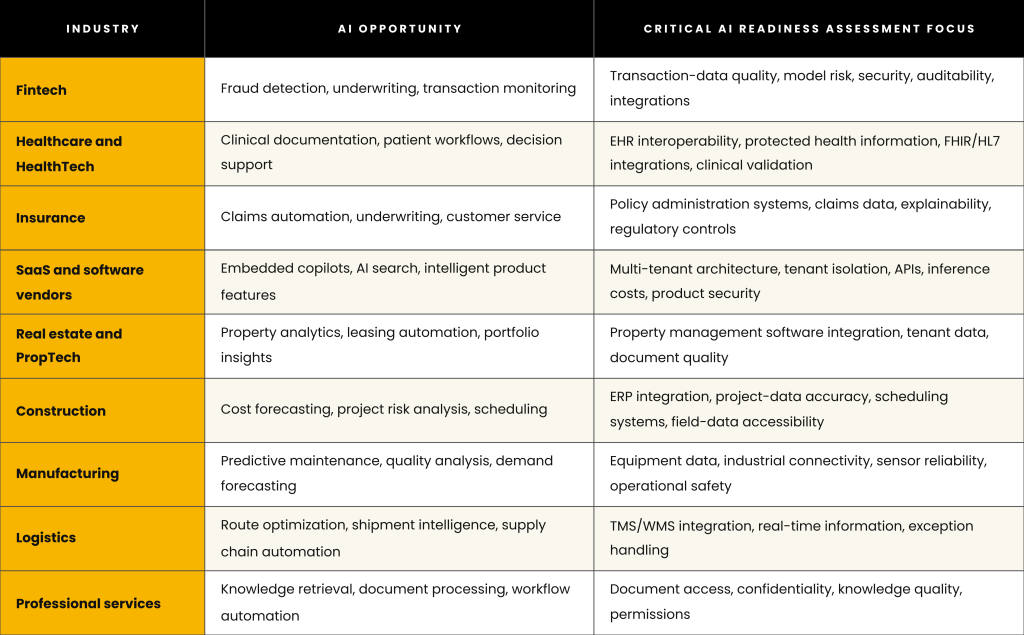
The right AI Readiness Assessment Report should reflect the actual technology environment and business risks of the company being evaluated.
Discover gaps in your data, applications, infrastructure, and AI adoption readiness with ISHIR’s Technical AI Readiness Assessment.
An effective assessment should move from business objectives to technical evidence, and then to an actionable implementation plan.
Start with the business problem, not the technology.
Does the organization want to reduce claims processing time, improve customer response quality, automate financial reconciliation, increase engineering productivity, or enhance operational forecasting?
Define the target workflow, expected value, business owner, and measurable success criteria.
Without a defined use case, even an extensive technology assessment can become too broad to guide investment.
Review the systems the proposed AI solution will interact with.
This may include applications, databases, cloud services, architecture diagrams, APIs, integrations, identity systems, and relevant infrastructure configurations.
Identify the dependencies, constraints, and technical debt that could prevent AI implementation.
Determine whether the required data is available, usable, governed, and accessible through appropriate interfaces.
Evaluate how information moves between systems and whether the proposed AI workflow can retrieve or process it reliably.
For retrieval-augmented generation, this also means testing document quality, retrieval relevance, access controls, and source attribution.
Examine how AI will access information, use tools, interact with applications, and influence decisions.
Identify safeguards needed for sensitive information, human approvals, logging, monitoring, testing, and incident response.
Different applications require different controls. A customer support knowledge assistant should not be evaluated against exactly the same risk criteria as an autonomous financial transaction workflow.
Classify the findings by business impact, implementation dependency, likelihood of failure, and remediation effort.
Some issues may require immediate attention before any pilot begins.
Others may be resolved through targeted integration work, data improvements, access control changes, or application modernization.
Not every technical gap requires a large transformation project.
A useful report must do more than label your company as ready or unready.
It should help leadership make investment decisions and give engineering teams a clear starting point.
An actionable AI Readiness Assessment Report should include:
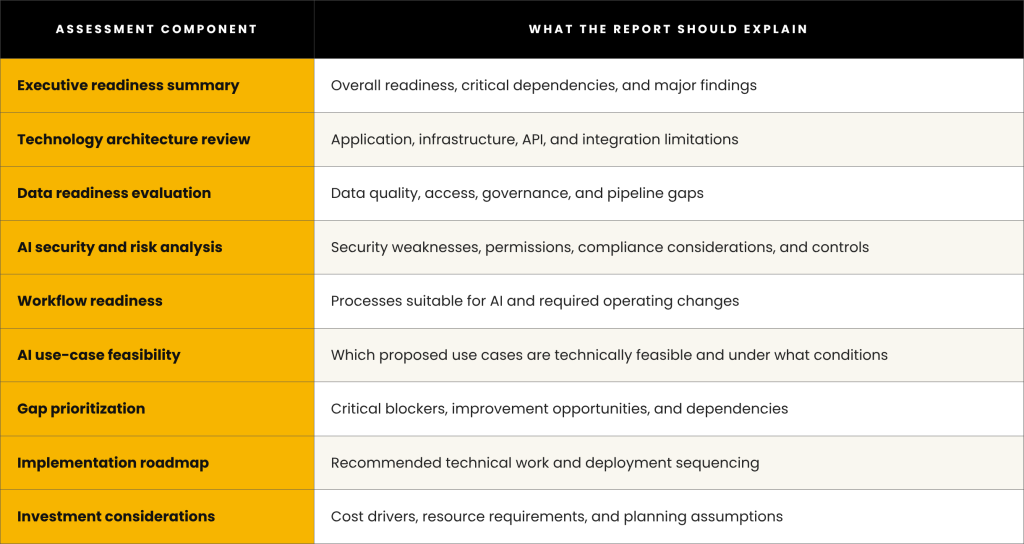
The most important distinction is between a report that gives you a score and one that explains what to do next.
A company with strong cloud infrastructure but unreliable customer data may be ready for some AI applications and unprepared for others.
A business with legacy applications may still adopt AI successfully through carefully designed integrations.
AI readiness is not a single yes-or-no decision. It is a practical evaluation of whether specific AI capabilities can operate safely and deliver value within your existing business environment.
Yes. An AI readiness assessment does not automatically mean replacing your ERP, CRM, databases, or enterprise applications.
In many cases, businesses can adopt AI by improving integration capabilities, introducing secure APIs, strengthening data pipelines, modernizing selected components, or redesigning workflows.
A technical assessment helps determine where targeted improvements are sufficient and where deeper modernization is unavoidable.
For example, an older customer management application may not support native AI features. But if it can safely expose required data through an integration service, an AI assistant may still be able to support selected workflows.
The decision depends on technical feasibility, data quality, security, operational risk, and cost.
The objective is not to rebuild your technology environment for AI. It is to identify the changes required to support the AI outcomes your business actually needs.
Adopting AI requires more than selecting a model, purchasing software licenses, or launching a pilot.
It requires understanding the technology systems already running your business and determining how AI can work within them.
ISHIR helps organizations evaluate the technical foundations of AI adoption, including enterprise architecture, application modernization, data engineering, integrations, cloud infrastructure, AI security considerations, and operational workflows.
The objective is straightforward: Make informed AI investment decisions based on your organization’s actual technical readiness.
AI adoption is becoming a business imperative. But urgency does not make existing technical limitations disappear.
Fragmented data will not become reliable because an AI model is more capable.
Legacy applications will not automatically support secure integrations.
Unclear permissions will not become safe when software is described as intelligent.
And a successful demonstration will not guarantee a successful enterprise deployment.
Your business may already have everything required to begin adopting AI. It may need targeted improvements. Or it may have critical technical constraints that should be resolved first.
An AI Readiness Assessment helps distinguish between those situations.
Before committing to another AI initiative, evaluate the systems, data, architecture, and workflows that will determine whether it succeeds.
The organizations that benefit most from AI in 2027 will not necessarily be those that purchase the most AI tools.
They will be the ones that understand their existing capabilities, address the right constraints, and deploy AI where it can deliver measurable business value.
The question is no longer whether AI can transform your business. The question is whether your business is technically prepared to make that transformation work.
An AI readiness assessment evaluates an organization’s data, technology, infrastructure, security, workflows, governance, and operating capabilities to determine whether it can successfully adopt and scale artificial intelligence. It identifies technical gaps, implementation risks, and recommended improvements.
An AI readiness assessment helps organizations identify integration limitations, poor-quality data, security risks, infrastructure constraints, and unclear business requirements before investing in implementation. This helps reduce avoidable technical rework and supports better investment decisions.
A technical AI readiness assessment typically includes application architecture, APIs, data accessibility, infrastructure capacity, security controls, integration capabilities, workflow dependencies, operational readiness, and use-case feasibility. The exact scope depends on the organization’s systems and objectives.
The cost depends on the organization’s size, number of systems, technical complexity, assessment depth, and regulatory requirements. A preliminary questionnaire-based assessment requires less effort than an enterprise-wide technical review involving architecture validation, integration testing, and detailed remediation planning. Businesses should request a defined scope and deliverables before comparing estimates.
A preliminary readiness questionnaire may be completed in a single session. A detailed technical assessment can require several weeks or longer, depending on access to architecture documentation, technical stakeholders, systems, and data. The duration should be established through an agreed assessment scope.
Yes. Small and mid-sized businesses can use an AI readiness assessment to identify affordable use cases, understand technical constraints, assess security risks, and avoid unnecessary technology purchases. The assessment should be proportionate to the organization’s size, systems, and investment plans.
An AI readiness assessment focuses on whether an organization has the capabilities necessary to implement particular AI solutions. An AI maturity assessment evaluates how developed and consistently applied an organization’s AI capabilities are over time. They overlap, but readiness is more directly tied to implementation feasibility.
Yes, depending on the architecture, integration capabilities, data accessibility, and security requirements of the existing systems. An AI readiness assessment can determine whether secure APIs, middleware, data pipelines, or targeted modernization would make AI adoption feasible without replacing the entire application environment.
Common barriers include fragmented data, poor data quality, legacy application constraints, missing integrations, weak access controls, inadequate monitoring, insufficient infrastructure capacity, and poorly defined workflows. The relative importance of each barrier depends on the proposed AI use case.
Businesses should receive a clear evaluation of their current capabilities, prioritized technical risks, implementation dependencies, recommended improvements, and next steps. A detailed engagement may also provide an architecture gap analysis, use-case feasibility assessment, and phased implementation roadmap.
The post AI Readiness Assessment: Is Your Business Technically Prepared to Adopt AI in 2027? appeared first on ISHIR | Custom AI Software Development Dallas Fort-Worth Texas.


