
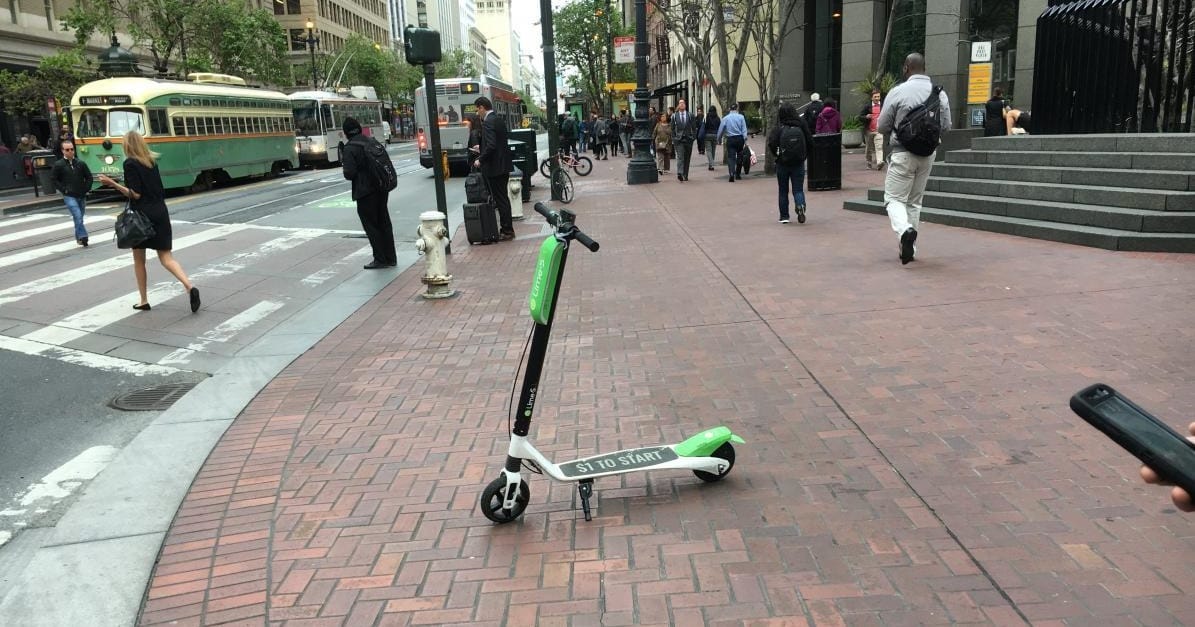
Lime is adding AI-powered cameras to its SF scooters to deter sidewalk riding amid rising injuries and complaints about reckless riders, though questions remain about how the data is stored and used beyond safety.
About 30% of Lime's San Francisco scooter fleet currently has the cameras installed, with the company expecting to outfit its entire fleet by next year, as KRON4 reports.
According to GeekWire, Lime's new Lime Vision technology uses front-mounted cameras and artificial intelligence to determine whether a scooter is traveling on a street, bike lane, or sidewalk. When the system detects sidewalk riding, it emits an audible alert and sends a notification through the Lime app telling the rider to move to a permitted area. The alerts continue until the scooter leaves the sidewalk or the rider ends the trip.
The technology comes as injuries involving electric scooters and e-bikes continue to raise concerns. According to the San Francisco Municipal Transportation Agency (SFMTA), there were 210 severe injuries involving e-scooters last year, and another 116 during just the first six months of this year, per KRON4. Meanwhile, 311 reports of sidewalk riding have also surged since 2024.
Lime's rollout in SF follows an earlier deployment in Seattle, which was the first city to receive the technology. The Seattle Times reported in May that the company began testing Lime Vision there ahead of the rollout, with plans to equip approximately 3,500 scooters, or half its Seattle fleet, by June and the entire fleet by the end of the year.
Parker Dawson, Lime's senior regional lead of government relations for the Pacific Northwest, described the audible alerts as a way to make both riders and pedestrians aware when a scooter is being used somewhere it shouldn't be.
“The audible alert very clearly makes you and others around you aware that the vehicle is not where it's supposed to be,” Dawson said., speaking to GeekWire
Lime, which is based in SF, began developing the camera-based system in 2022, initially planning pilot programs involving nearly 400 scooters in San Francisco and Chicago, as TechCrunch reported at the time. Before investing in its own technology, the company tested systems developed by third-party providers that use computer vision to identify sidewalk riding.
The original camera units were reportedly designed to be retrofitted onto existing scooters, with Lime also developing a version that would be integrated directly into the vehicle.
According to TechCrunch, the technology could eventually be used for more than detecting sidewalk riding. Lime has discussed using the cameras to identify improperly parked scooters, pinpoint areas where riders frequently travel on sidewalks, and provide cities with information that could help determine where additional protected bike lanes are needed. The company also plans to extend Lime Vision to its e-bike fleet.
There are also unanswered questions about what happens to the footage captured by the cameras. Lime's privacy policy says images from camera-equipped vehicles are used to identify road and sidewalk boundaries and other surroundings for safety purposes. It also acknowledges that Lime may collect images and video footage of rides, but the company does not specify how long footage from Lime Vision cameras is retained, whether it is transmitted or stored, or whether it is used for purposes beyond safety detection.
The policy does allow for certain personal information to be shared with service providers, government agencies, and local authorities.
In a 2022 interview with Auto Futures, Lime's Alan Clarke said visual data collected through Lime Vision would be stored on US cloud servers to train city-specific algorithms and deleted once that training was complete. However, it's unclear whether that explanation still reflects the company's current data practices or how it applies to the San Francisco rollout.
Per KRON4, SF Supervisor Danny Sauter has voiced support for the technology but says Lime, Lyft, and other companies operating shared bikes and scooters need to coordinate on pedestrian safety. He also emphasized that camera technology alone won't address the underlying infrastructure problems.
“We need more protected bike lanes. We need more dedicated bike and scooter parking so they aren’t cluttering sidewalks,” Sauter said.
Sauter noted that privately owned e-bikes and scooters are more difficult for the city to regulate and encouraged residents to report sidewalk riding through the city's 311 app, including submitting photographs when possible.
Related: City Extends Lime, Spin Permits But Doesn’t Address Widespread Scooter-Related Complaints


